Getting WDG JR+ Right:
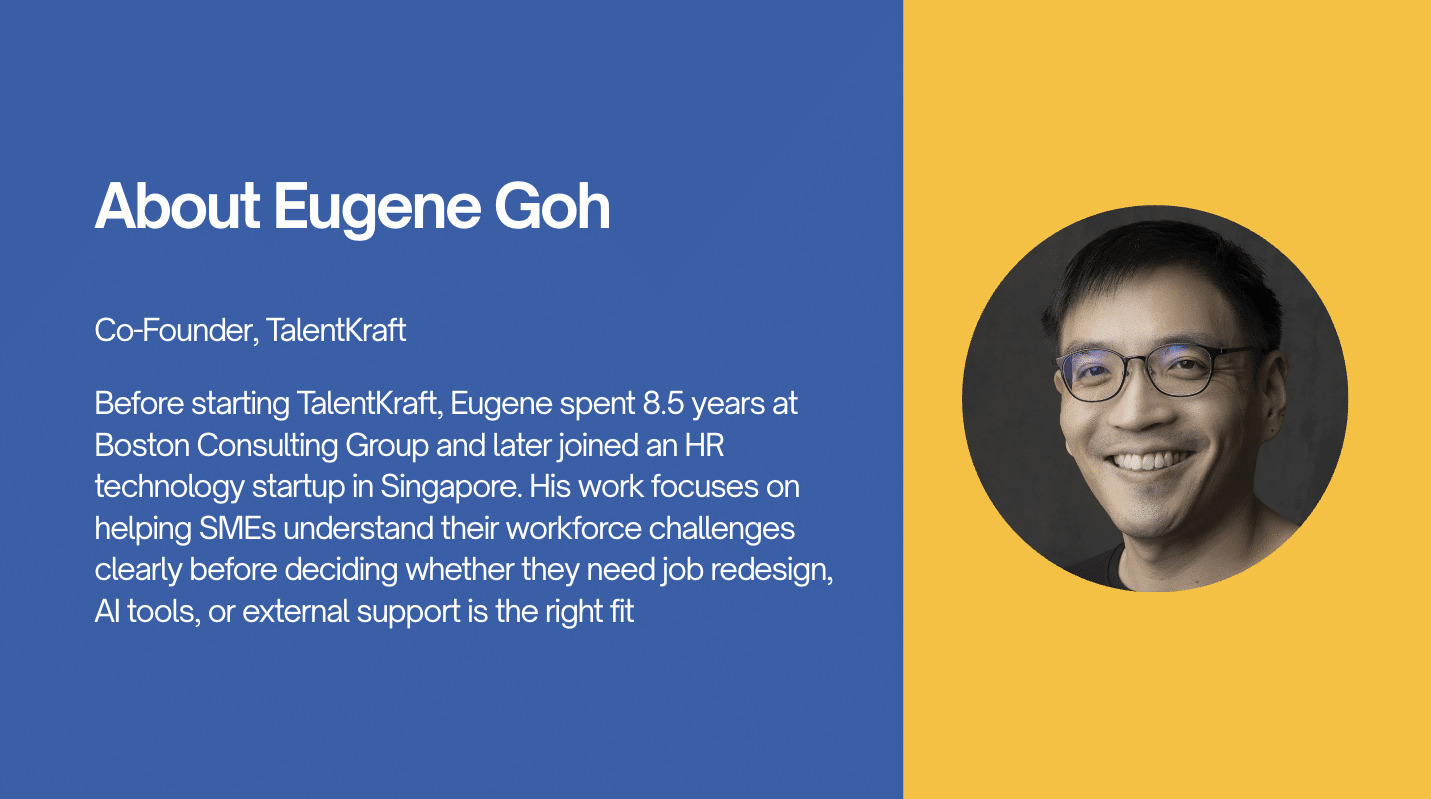
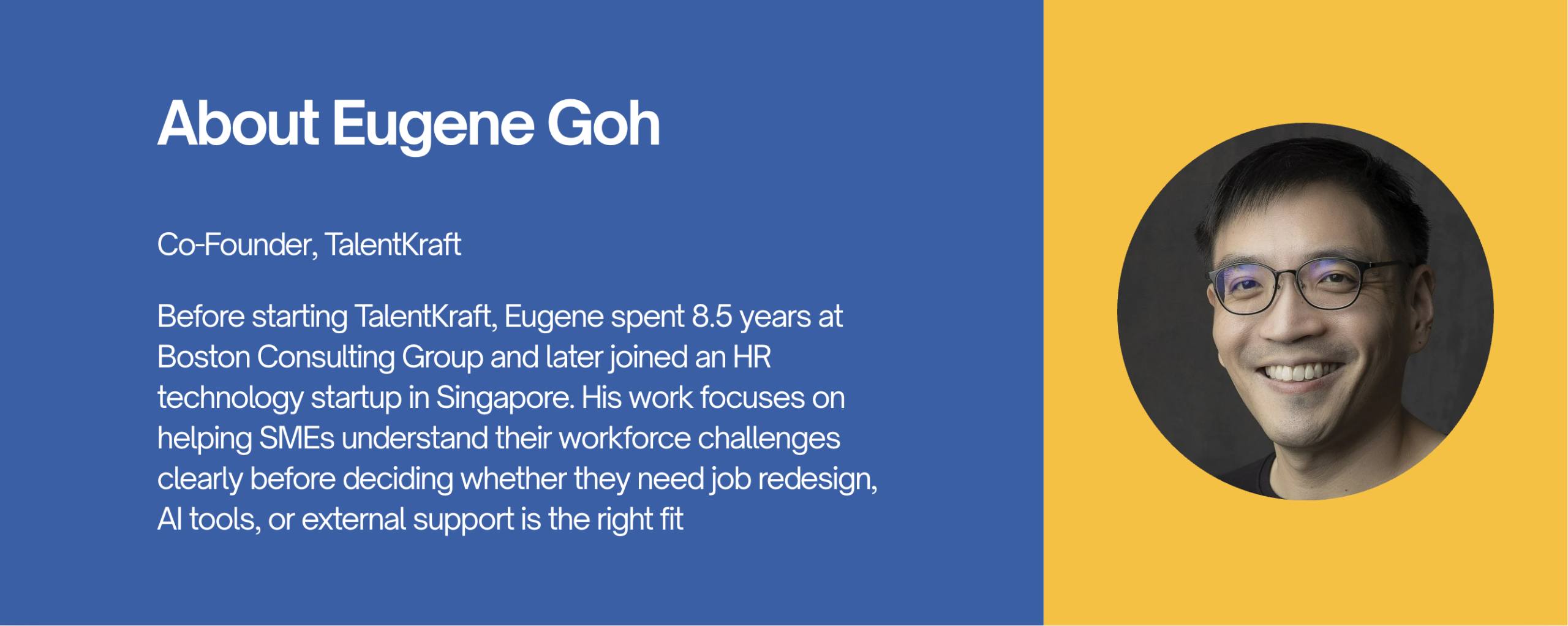
Eugene Goh on the right way to approach workforce transformation
As part of our new series, Getting WDG JR+ Right, we speak with Eugene Goh, Co-Founder of TalentKraft, on how organisations can approach job redesign and workforce transformation more thoughtfully. Many organisations know they need to change how work gets done, but the harder question is where to start. Should they redesign roles, adopt AI tools, apply for WDG(JR+), or bring in external support? For Eugene, the answer should not begin with the grant. It should begin with understanding the real business problem.
In this conversation, Eugene shares why successful workforce transformation depends on asking better questions upfront, diagnosing workforce issues clearly, and choosing the right intervention only after the problem is understood. TalentKraft is a pre-approved consultant for the SkillsFuture Workforce Development Grant (Job Redesign+), also known as WDG(JR+).
Q: What is one thing about HR consulting in Singapore that people often misunderstand?
A: The first confusion is that most people think HR consulting means you’re a headhunter or recruiter! We need to explain that we are here to help them solve the underlying problems and unlock business value. We apply the methodologies of the top global consulting firms to help local companies recruit better, retain better, and thrive in a challenging business environment.
Q: What does TalentKraft do differently from larger consultancies?
A: We frequently encounter clients who are deciding between TalentKraft and big brand-name consultancies. To us, the difference is very clear. With TalentKraft, the partners you see in the pitch are the ones executing the project on the ground every day. We do not just show up at the pitch and invoicing stages. Each project and each client is a key part of our portfolio of work, so each one gets our full attention. In a large firm trying to hit billion-dollar revenue targets, you may not get the same level of attention.
Q: What does the first 30 days of working with TalentKraft usually look like?
A: In the first 30 days, we spend a lot of time understanding the organisation and getting to the root causes of its workforce challenges. It can be tempting to assume that all SMEs are alike, or that we can copy-paste a solution from a previous project. But every company has different business priorities, people issues, and constraints. So the first part of any engagement is about asking the right questions and gathering data, not just relying on opinions.
This could involve an employee engagement survey, team motivation mapping, or strategy discussions with senior management. From there, we link our recommendations back to the company’s business goals, so that workforce transformation does not happen in a vacuum.
Q: If a CEO wants to use JR+ to future-proof the workforce, where would you start?
A: The first step is to diagnose the real issues. Rather than rush into scoping a project, we work with clients to identify the critical problems that need to be addressed. Once the problem is clearly defined, we can decide how a JR+ project should be structured. The solution is usually a combination of workforce consulting and capability building. That means both managers and HR need to be equipped to redesign jobs and manage change over time. Future-proofing the workforce is not something that can be solved through a one-off project.
Q: With AI tools becoming more accessible, what role do consultants still play in workforce transformation?
A: AI tools can make workforce transformation easier, but they do not replace the need to understand the organisation properly. Many SME HR teams are already stretched with day-to-day operations, so it can be difficult for them to step back, diagnose the root issues, and redesign roles in a structured way.
External consultants can help by bringing a fresh perspective, tested methods, and experience from working across different organisations. The value is not just in recommending tools, but in helping companies decide what problem they are actually trying to solve, what needs to change in the way work is done, and how managers and employees can sustain those changes over time.
For eligible companies, WDG(JR+) can also make this type of work more accessible. The grant provides funding support of up to 70% for SMEs and 50% for non-SMEs, capped at $150,000 per enterprise. It supports workforce consultancy, capability building, and workforce tech solutions, including tools related to workforce analytics, skills gaps, and AI-powered HR technology.
Q: When might JR+ not be the right fit?
A: JR+ may not be suitable for every company. For example, a company that mainly wants to digitize its finance or sales function may be better off exploring other grants, such as Company Training Committee grants from NTUC or Enterprise Development Grants from EnterpriseSG. The key is not to start with the grant and work backwards. Start with the problem, and find the right tool for it.
Q: Which types of organisations tend to get the most out of JR+ funding
A: JR+ is most useful for companies that want to improve how their HR team works. This could involve automation, AI tools, HR job redesign, or upskilling the HR team. When done well, HR transformation can directly support business outcomes such as faster hiring, stronger employee retention, and better employee engagement. Companies can also combine JR+ with Career Conversion Programmes for HR, which may provide salary support as their HR teams upskill.
JR+ is also designed to support job redesign. Consultants can help companies redesign roles as part of a wider workforce project, while also building internal capability so that HR teams can continue working with line managers as job requirements change.
Across this conversation, one theme came through clearly: WDG(JR+) works best when it supports a real workforce transformation need, not when it is treated simply as available funding. The organisations that benefit most are those that start with the problem, define what needs to change, and use the grant as one possible tool to support that change. If that is the kind of transformation you are trying to build, TalentKraft can help you get there.
Like this blog?
Stay tuned for next week’s conversation in Getting WDG JR+ Right.
TalentKraft offers solutions specially catered to your startup’s HR and scaling challenges.
GrowthKraft
Recruiting in a Box
Want to get insights on your team's culture?
Click on this button to find out how you can do that with TalentKraft’s TeamSight.