Getting WDG JR+ Right:
Yang Ming Ong on building restaurant operations that scale
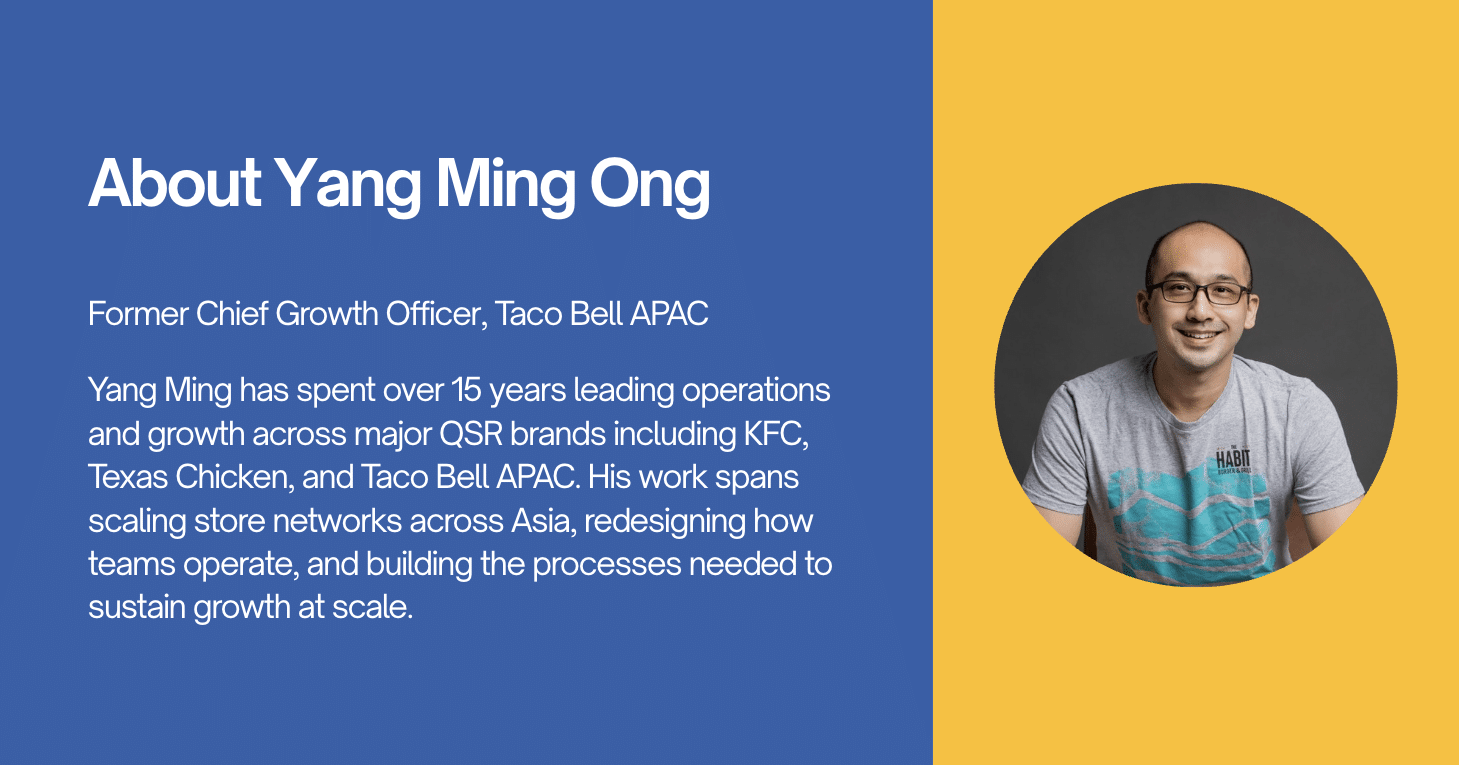
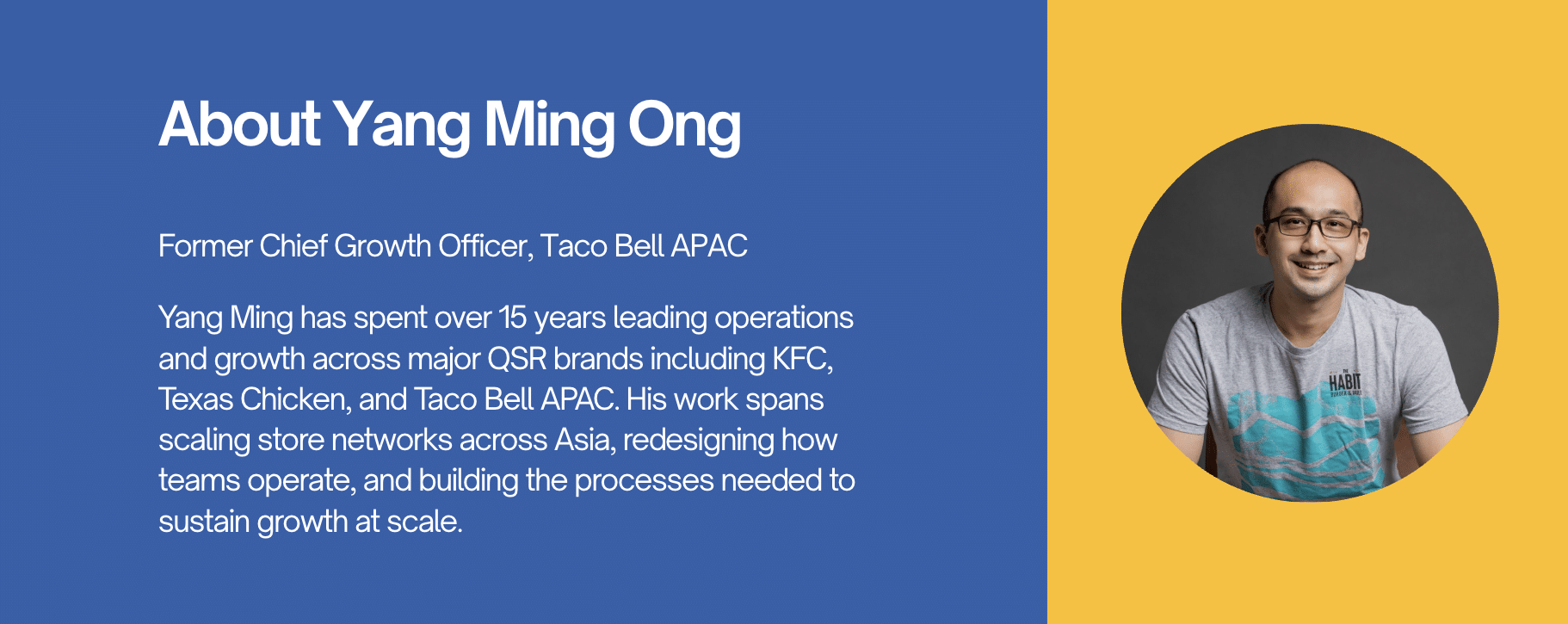
As part of our new series, Getting WDG JR+ Right, we speak with Yang Ming Ong, former Chief Growth Officer, Taco Bell APAC and Adjunct Consultant at TalentKraft, whose leadership experience spans KFC, Texas Chicken, The Habit Burger Grill, and Taco Bell, on how F&B businesses can approach growth, operations, and job redesign more thoughtfully. Many businesses know they need to improve how work gets done, but the harder question is where to start. Should they redesign roles, adopt AI tools, invest in new workflows, or apply for WDG(JR+)? For Yang Ming, the answer should not begin with the grant. It should begin with understanding the real operational problem.
In this conversation, Yang Ming shares why sustainable growth depends on getting the fundamentals right first: strong operations, practical job redesign, and tools that frontline teams can actually use. Drawing on his experience across major QSR brands, he explains how businesses can scale more effectively by reducing friction, supporting managers, and solving the right problems on the ground. TalentKraft is a pre-approved consultant for the SkillsFuture Workforce Development Grant (Job Redesign+), also known as WDG(JR+).
Q: Tell us about your career journey, from BCG to KFC, Texas Chicken, and most recently Taco Bell APAC. How has that path shaped the way you think about growth, operations, and building teams that can scale?
A: I started in strategy consulting at BCG because I wanted the broadest possible platform. What I thought would be a two-year stint turned into eight years because I loved the steep learning curve and the exposure it gave me. Eventually, I realized my real passion was in consumer businesses, which led to a rare move from strategy into operations at Yum! Brands, starting with KFC.
My early days at KFC fundamentally shaped my view of F&B. Yum sent me through three months of hands-on restaurant training at a company-owned store in Sydney. Working the line taught me the vital difference between what exists in an operations manual and what actually happens during a dinner rush.
Today, whenever I evaluate a new growth strategy or tool, I ask one question: “Can a 19-year-old part-timer execute this during a peak rush?” If the answer is no, it is just a consultant’s pipe dream.
Q: From growing Texas Chicken across 16 countries to scaling Taco Bell APAC, what are the most common workforce and operational challenges you have seen as F&B businesses grow? How do these problems tend to compound if they are not addressed early?
A: People often think launching a brand is the hardest part. It is not. Building opening-day hype and getting long queues is relatively easy. Sustaining that demand is the real challenge.
The biggest mistake expanding brands make is getting carried away with launch-day success and rushing to open more units. If you scale before your core operations, training, and unit economics are solid, teams get stretched, focus gets split, and quality starts to drop. Marketing gets guests through the door the first time, but only strong, consistent operations bring them back.
Q: Where are F&B businesses getting the most value from AI and technology today? Where are they still struggling to make these tools work, and why are some operators still resistant?
A: F&B has historically been a traditional industry, but technology is now unlocking value across two main areas.
On the customer-facing side, businesses are using technology to drive more personalized loyalty programmes and smarter self-ordering interfaces. Behind the scenes, technology is removing friction for store managers through intelligent sales forecasting and automated inventory management.
The struggle is not the software. It is execution on the floor. F&B relies heavily on part-time staff and faces high turnover. If an AI tool requires extensive training or adds friction to an employee’s shift, adoption dies very quickly.
Q: At Taco Bell APAC, you led a workforce redesign initiative for a new compact store format. What role did technology play in that process, and what did it take to make it work on the ground?
A: Compact store design is not just about shrinking real estate. It is about optimizing human movement and ergonomics.
We used technology to analyze time utilization, task sequences, and equipment layout. Because smaller footprints demand multi-skilled team members who can move seamlessly across roles, job redesign was central to the process. To make it stick, we involved store teams early in prototyping. If frontline staff do not buy into the workflow layout, even the smartest engineering fails.
Q: As AI and automation become more common in F&B operations, what skills will become more important for frontline employees and managers? How can operators build these capabilities without making training too expensive or complicated?
A: Hospitality is an emotional connection. Technology is merely an enabler. The push toward restaurant automation is not brand new, and looking back shows us where technology alone falls short.
Take Eatsa, the fully automated fast-casual chain that operated from 2015 to 2019. It built sleek, futuristic stores where guests ordered through kiosks and retrieved meals from glowing LCD glass cubbies without ever seeing a human worker. While the concept was visually striking and initially popular for its novelty, it quickly struggled with guest retention. The experience felt cold, transactional, and sterile, showing that removing human interaction entirely can strip away the soul of hospitality.
Automation should be used to clear away administrative clutter so staff can focus more on warmth, empathy, and service. Operators should focus training on soft skills, hospitality mindsets, and conflict resolution, while letting technology handle the repetitive mechanics behind the scenes.
Q: Job redesign is often seen as a back-office exercise. From your experience running operations across hundreds of stores and multiple markets, why does it actually matter for business performance, and why do operators underestimate it?
A: In retail, people often say “the customer is king.” In high-performing F&B brands, we know that the team is at the core of the customer experience. Unhappy, overwhelmed staff inevitably deliver poor guest experiences. A restaurant manager’s job today is much more complex than it was a decade ago. Managers now juggle third-party delivery tablets, self-ordering kiosks, dynamic labour scheduling, inventory technology, and a very different workforce dynamic.
Without job redesign, managers get bogged down in administrative noise instead of coaching their teams and engaging guests. For instance, Yum China re-engineered store operations by launching a unified “one-stop” digital service centre for restaurant managers. Instead of managers calling multiple vendor hotlines for technology or facility issues, headquarters redesigned its back-office support into a centralized shared services model.
This stripped away store-level administration and allowed store leaders to spend more time where it drives revenue: on the floor.
Q: When a role or workflow is redesigned well in an F&B or franchise context, what actually changes day to day?
A: The fundamental tasks of F&B, such as cooking, assembling, and hosting, do not disappear. But the friction around them reduces. When job redesign is done well, a shift feels calmer and more intuitive. Multi-tasking becomes fluid rather than chaotic, physical ergonomics improve, and administrative overhead drops significantly.
For the employee, turnover decreases because fatigue drops. For the business, higher retention translates directly into faster speed of service, better food quality, and higher guest satisfaction scores.
Q: How do frontline employees and store managers usually respond when F&B businesses introduce new technology or new ways of working? What makes them more likely to accept or resist, and when it lands well, what does that look like for the employee?
A: Frontline teams naturally resist change when technology feels like it is being imposed on them to monitor performance or cut hours. They embrace it when it clearly removes a headache from their daily routine.
The key to driving adoption is early involvement and positioning technology as an assistant, not a replacement. When a rollout lands well, store managers stop viewing new tools as extra administration and start seeing them as cheat codes that make their shifts run smoother and end on time
Q: Programmes like WDG(JR+) are meant to help companies with job redesign and workforce transformation. How should business leaders use these resources properly, instead of treating them as just another grant application?
A: Do not start with the grant. Start with the operational bottleneck.
If you treat programmes like WDG(JR+) as merely a financial subsidy, you may end up with a nicely bound report that sits on a shelf collecting dust. Leaders should first identify their biggest operational friction points. Where are staff burning out? Where is labour productivity stalling?
Use WDG(JR+) as a catalyst to fund structural workflow changes, technology integration, and capability building that deliver long-term ROI after the grant cycle ends.
Q: If you could give one piece of advice to a business owner in Singapore who wants to start redesigning how their team works or adopting new technology but does not know where to begin, what would it be?
A: Start small, walk the floor, and solve for one real headache. Do not try to transform your entire operation overnight. Pick one specific role and one key workflow where your team currently loses time, experiences friction, or gets frustrated.
Spend time on the frontline observing that process firsthand. Then redesign it end-to-end using simple technology enablers.
Once your store team experiences how job redesign directly improves their day-to-day working life, they will naturally become your biggest advocates for broader transformation across the business.
Like this blog?
Stay tuned for next week’s conversation in Getting WDG JR+ Right.
TalentKraft offers solutions specially catered to your startup’s HR and scaling challenges.
GrowthKraft
Recruiting in a Box
Want to get insights on your team's culture?
Click on this button to find out how you can do that with TalentKraft’s TeamSight.